Pirates Open to Trading Starting Pitching, Could Be Cubs Trade Partner

In his latest piece about the Pirates trading away Johan Oviedo, Ken Rosenthal reported that the Pirates are open to trading another starting pitcher not named Paul Skenes. So while it still feels like it’s only a matter of time before that domino falls and Skenes gets shippied out of Pittsburgh, it isn’t likely to happen this season.
Despite having perhaps the best pitcher in baseball, the Pirates finished in last place in the NL Central with just 71 wins. Their lack of success mainly stemmed from a weak offense, one that scored an MLB-worst 583 runs. Their rotation was fantastic, with a 3.71 ERA that was sixth best in the sport, so they had several other strong starters. As those options become available on the trade market, it would be wise for the Cubs to consider an intradivision trade to bolster their own staff.
The Cubs could use more velocity in the rotation, and the Pirates have plenty of it. As our Evan Altman mentioned on X, every presumed member of their rotation sits 95 mph or higher. That’s a foreign concept for the Cubs, who currently have only one starter throwing above 94 mph. That wouldn’t be helped by Mitch Keller, who seems like the pitcher the Pirates would be most motivated to move based on the three years and nearly $56 million remaining on his contract.
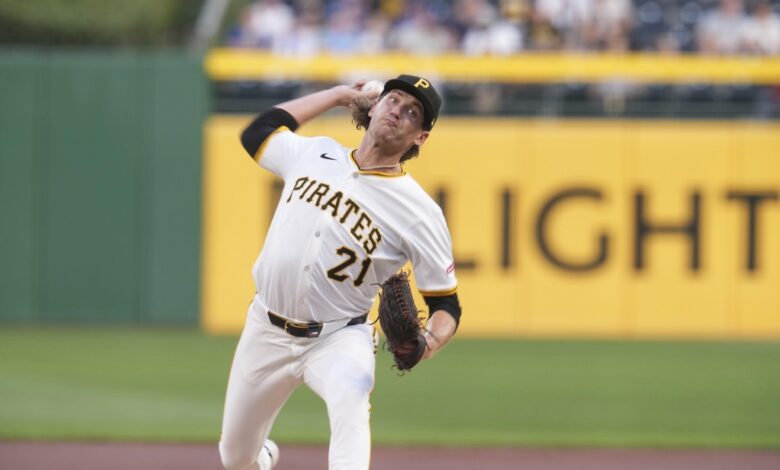
If the Pirates trade Mitch Keller and move Braxton Ashcraft (97 mph) to the rotation full-time, they'd have a very hard-throwing rotation that includes Paul Skenes (98.2), Jared Jones (97.3), Bubba Chandler (98.9), and Mike Burrows (95.5). Imagine sitting 95.5 and being "slow."
— Evan Altman (@DEvanAltman) December 5, 2025
Bubba Chandler, who MLB Pipeline has as the 14th-best prospect in MLB, is close to untouchable and isn’t moving unless a team really pays up. If the Cubs want someone with plenty of team control at what could be a reasonable cost, Braxton Ashcraft may be the answer. The idea of Owen Caissie — who was rumored to be part of a potential Keller deal at the deadline — going back in return is intriguing, although it might not make as much sense for Pittsburgh.
Owen Caissie for Braxton Ashcraft is a deal that makes a whole lot of sense for both sides https://t.co/56Dzr5cqm5
— FullCountTommy (@FullCountTommy) December 5, 2025
The 26-year-old Ashcraft debuted in late May and logged 69.2 innings across 26 games in his rookie season, making eight starts along the way. He has a 97 mph four-seam with a 92 mph slider that rivals the velo of some Cubs’ fastballs. Ashcraft’s 50.8% groundball rate is particularly appealing due to the strong infield defense Jed Hoyer has built, and he does a great job of avoiding hard contact. His 4.6% barrel rate put him in the 94th percentile and his 88 mph average exit velo was in the 80th percentile.
Baseball Savant is always a useful tool when researching pitchers, and it provided some intriguing comparisons when it came to Ashcraft’s velocity and movement. Hunter Brown, Cam Schlittler, and Edward Cabrera are all noted as being similar to Ashcraft. Comps alone can’t determine whether a player is worth acquiring, but that’s some really solid company. As if the possibility of adding Ashcraft to the rotation wasn’t good enough already, he won’t be a free agent until 2032.
The only problem is that it’s going to take a lot to pry him loose. The idea of moving Caissie would have made more sense before the Pirates acquired outfield prospect Jhostynxon Garcia, who should complete an outfield that features Oneil Cruz and Bryan Reynolds. If the Cubs need to pivot to another young prospect, perhaps Ben Cherington is a fan of Moisés Ballesteros. Cubs fans may not love that idea, but Ballesteros doesn’t have a clear everyday spot on the team as of now and could net Hoyer some pitching for the future.
Or perhaps the Cubs could go a different route by targeting Jared Jones. The 24-year-old missed all of the 2025 campaign due to elbow issues that eventually required reconstructive surgery in May. It was an internal brace procedure, much like what Justin Steele underwent, which typically results in a faster return to play than traditional Tommy John. Jones was already playing catch three times a week as of mid-September and could be ready to pitch by midway through the first half of next season.
There’s some concern because of his surgery, but the upside is exciting. Jones is a fastball-heavy pitcher, striking out just over a quarter of the batters he faces with his riding 97 mph heater and bullet slider. He may cost more than other available Pirate pitchers, but he has four years of control remaining and is someone to keep an eye on.
Keller remains an option as well, though he’s easily the least enticing of the bunch because he’s far more expensive and doesn’t have nearly the same stuff. He’s coming off a rather average year that included a 4.19 ERA and 1.26 WHIP in 176.1 innings. He continued to limit walks, which is good for a guy who doesn’t strike out many batters, but he gave up a lot of hard contact. The Iowa native is under contract for three more seasons at what would be around $18.6 million AAV if traded, which might not be ideal for a No. 3 or 4 starter.
It’s clear that the Cubs are going to be very active in the starting pitching market, whether it’s through free agency or trades. The Pirates may provide an opportunity to add a high-upside arm without impacting payroll to a great degree, leaving potential to shop the free agent market later if needed.