World Baseball Classic Massive Success Despite One Clear Flaw

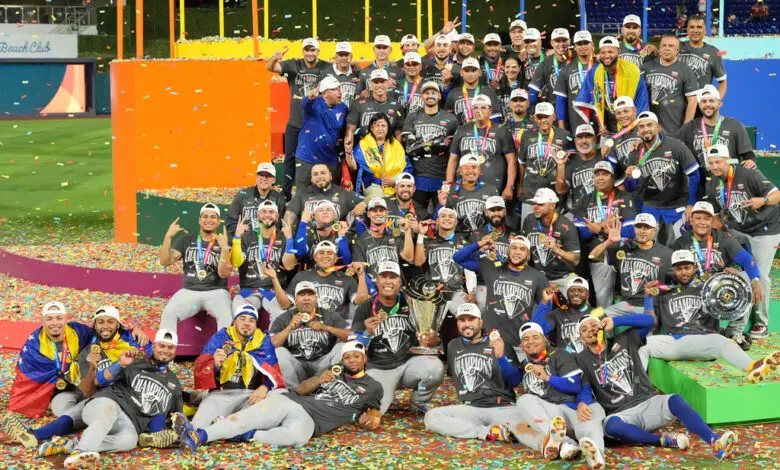
Team Venezuela won its first World Baseball Classic championship on Tuesday night, shocking the baseball world with a 3-2 win over Team USA. Venezuela beat the reigning champions in Team Japan to open bracket play, then ended Italy’s Cinderella story en route to the championship game.
Team USA had an easier path out of pool play on paper, but a possible strategic blunder by manager Mark DeRosa took destiny out of their hands. As such, they had to wait to see what happened between Italy and Mexico in hopes of advancing based on specific tiebreaker rules. The Americans survived and then beat the Dominican Republic in an instant classic.
Last up was the championship game between two loaded lineups that were full of MLB talent. In a somewhat unexpected result, Eduardo Rodriguez and the Venezuelan pitching staff shut down the US lineup until the 8th inning, when Bryce Harper tied the game with a two-run blast to center field. Eugenio Suárez and Team Venezuela took the lead back right away, and the rest is history.
Throughout the tournament, there were so many special moments that will be remembered in baseball history forever: walk-offs, towering home runs, incredible defense, and so much more. The viewership numbers proved that the product on the field was working, and fans couldn’t get enough of the high-stakes baseball.
The 2026 World Baseball Classic Final across FOX and Fox Deportes: 10.87 million viewers
The 2025 NBA Finals average across 7 games: 10.2 million viewers
(Via @FOXSportsPR) pic.twitter.com/eppmGPCaNe
— Just Baseball (@JustBB_Media) March 20, 2026
Among all of these highlights and positives is one clear problem that needs to be fixed moving forward. Too many pitchers were limited in their throwing by their respective MLB teams. It makes sense that coaches and GMs don’t want to see their players get hurt in this tournament; that’s not unrealistic at all. However, coaches in the WBC were constantly having to call MLB teams to adhere to their schedules, since these players were missing spring training.
Omar López, Team Venezuela’s manager, told the press that three different MLB clubs contacted him about restricting their pitchers before the championship game. One of those teams was the Cubs, who asked López only to use Daniel Palencia in a save situation. Palencia ended up closing out the game and securing the championship for his home country.
Venezuela manager Omar Lopez on potential pitching restrictions after heavily using his bullpen Monday night: ‘I woke this morning, three text messages from different organizations trying not to pitch guys back to back.’’’
He called them back trying to convince them to change…— Bob Nightengale (@BNightengale) March 17, 2026
DeRosa dealt with similar issues, with the Padres giving him similar instructions for electric closer Mason Miller. A save situation never arose, and DeRosa’s best reliever was sitting in the bullpen watching his team lose by one run in the big game. In a perfect world, DeRosa has the all-clear to use Miller in the 9th inning, which began as a 2-2 tie. Miller keeps it even and gives his team a chance to walk it off in the bottom of the frame.
Miller and Palencia were just two players who had to be restricted because their teams wanted to be cautious about their workload before the season began. As I mentioned above, that’s a completely understandable line of thought from their front offices, but it’s unfortunate that it had to affect this amazing tournament.
There are a few ways that MLB could go about this problem. One of them is a midseason tournament, which commissioner Rob Manfred said has been discussed. The NBA does its NBA Cup during the middle of the season, with players staying on their respective teams and playing for cash prizes. In 2025, each player on the winning team of the NBA cup received a $530,933 bonus. That dollar amount translates to almost 70% of the MLB league minimum, meaning a lot of younger players could use that money.
The solution that relates to this discussion is holding the World Baseball Classic over the All-Star break. If the regular season started a few days earlier, the All-Star break could be extended. Holding the tournament midseason would allow pitchers to already be ramped up, eliminating many of the restrictions related to health. The counterpoint is that teams in postseason contention might not want their players participating, but it is at least something to consider.
Future Hall of Famer Max Scherzer told Foul Territory that he wishes the tournament would be pushed back two weeks. Scherzer thinks this would increase the participation across the sport, dropping the injury risk for pitchers. Moving the tournament dates would likely mean losing a few games in the MLB season, Scherzer acknowledged, but it would be a minimal loss.
The 2028 Los Angeles Olympics, which will include baseball, add yet another wrinkle to the expanding interest in games between countries. The possibility of pausing the season will definitely be a discussion in the upcoming CBA negotiations, as the NHL set a fantastic example last month in Milan for the Winter Olympics.
It’s not the main thing that I want changed, but this hidden clause in the WBC bracket rules feels quite silly. It feels like a way to force Team USA to face Team Japan in the championship, which isn’t exactly fair to the countless other countries vying for those spots. Japan didn’t make it this year after losing to Venezuela, but the point still stands.
🚨This year's WBC bracket hides an absurd condition that no one's ever heard of. If the US and Japan both advance to the QF’s, they will be automatically be fixed in positions 2 & 4 of the QF bracket, regardless of their group stage result. Only the US & Japan have this condition
— KBO in English (@KBO_ENG) March 13, 2026
Regardless of how they approach the future of the World Baseball Classic, it’s clear that international interest in baseball is growing, and the sport continues to increase in popularity. With a potential lockout looming, baseball has a chance to benefit from the current talent pool, which is unlike any we have ever seen before. The interest, participation, and emotion that came out of this year’s WBC are proof that baseball is thriving.